

By Tope Salaudeen-Adegoke
Williams Ossai wrote The Power of Unity, which focuses on unity, as well as the beneficial and bad impacts of disunity. Citing Bible stories and using Biblical historical characters as examples.
The first chapter, welcoming brotherhood, discusses how the link of brothers can be developed through natural or spiritual birth. Citing the Bible’s account of Jonathan and David’s friendship. The author writes that friendship can arise without actively seeking it, and that circumstances may bring two individuals together as friends.
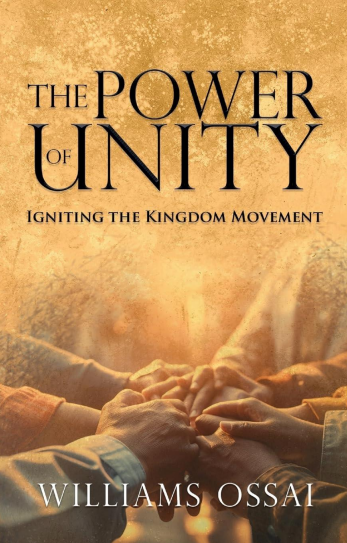
This book also explains the value of brotherhood. Envy, strife, and bitterness destroyed Cain and Abel’s relationship, which could have been beautiful if Cain hadn’t been jealous of Abel. He could have approached Abel for advice on how he harvests such good crops, and they could have worked together to produce good crops. But that was not the case. Cain allowed hatred and envy to overcome him until he murdered his brother, Abel.
It is critical to acknowledge the wicked character of certain of our emotions and treat them with love and righteousness.
Williams Ossai used biblical figures as examples to emphasize the potential of unity. Cain and Abel’s friendship, Adam and Eve’s fall from favor with God, and Abimelech’s violent thirst for dominance. These broken relationships in history are not isolated to the past; many modern families are disintegrating owing to a lack of love and unity. Many modern families nowadays lack unity, with sibling rivalry, parents disowning their children, and so on.

Spiritual bonds, such as the one formed between Jesus Christ’s 12 apostles, are excellent instances of oneness. It has both the positive and negative aspects of divisiveness. Jesus would not have been caught if Judas had not betrayed him. Just one disloyal individual changed Jesus Christ’s path and nailed him to the cross.
The book’s other chapter focuses on the power of cohabitation and living in harmony, while also focusing on the strength of togetherness and providing further examples from the Bible.
Williams Ossai emphasized the importance of unity in this book and not to underestimate its importance.
His writing style is frequently exhortative, similar to a sermon. The book appears to be geared on educating and motivating a Christian audience. The Bible is central to the book. Almost every idea is supported by bible scriptures, which the author interprets in the context of relationships, unity, and spiritual progress.
The book regularly employs biblical allegories, such as Cain and Abel, the Apostles, Jacob and Esau, and personal experiences, to hammer its points home. These narratives are designed to encourage thought and moral learning, which is a good thing. However, many of the main themes discussed throughout the book are repeated. Which may become dull. However, the book sees unity as a divine duty rather than merely a social virtue.
Click below to read the power of unity




 Culture Beyond the Mainstream