
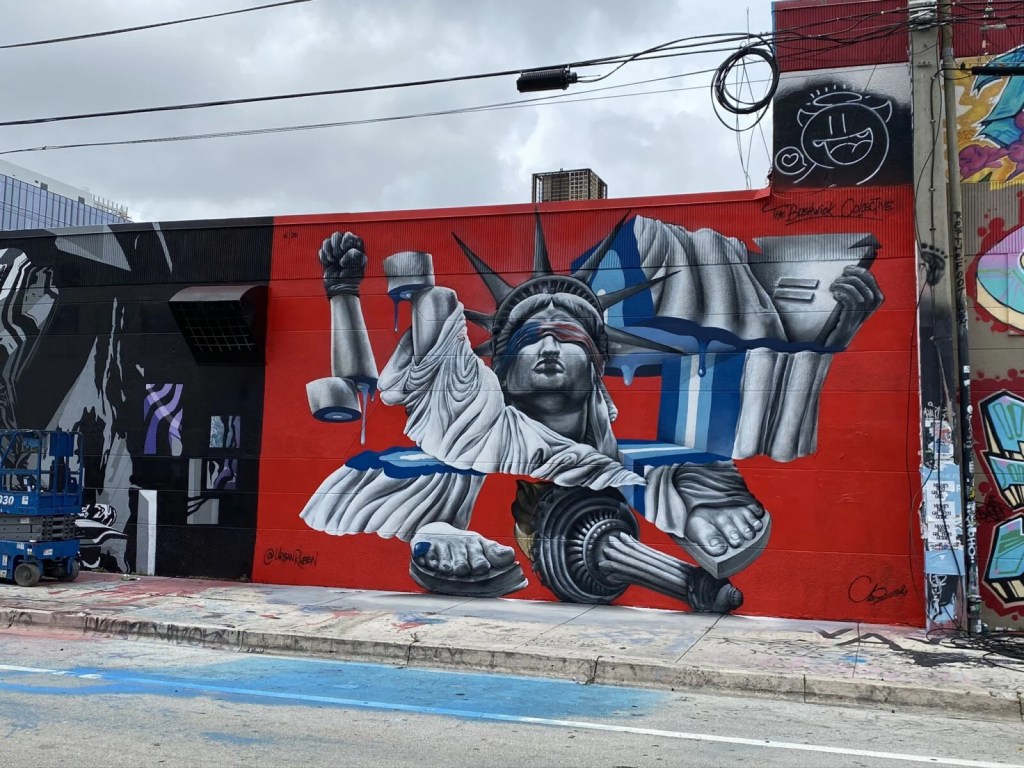
Across the United States, street art has become a powerful political archive, documenting moments of resistance, grief, solidarity, and dissent that often escape official historical records. Painted on walls, sidewalks, boarded storefronts, and public infrastructure, street art captures political feeling in real time, preserving public responses to injustice, crisis, and change in ways that institutions frequently sanitize or ignore.
American street art has long been intertwined with political struggle. From civil rights–era slogans painted during marches to anti–Vietnam War graffiti, public walls have functioned as spaces where marginalized voices asserted presence and demanded recognition. Unlike museums or state archives, these works emerged from the streets themselves, shaped by urgency rather than permission, and rooted in lived experience rather than formal authority.
In recent decades, street art has played a central role in documenting racial justice movements. Following police killings of Black Americans, murals bearing victims’ names and faces appeared across cities such as Minneapolis, Los Angeles, New York, and Atlanta. These works transformed everyday urban spaces into sites of mourning and protest, refusing to allow victims to be reduced to statistics or forgotten news cycles. In this way, street art preserved collective memory and challenged narratives that framed such events as isolated incidents rather than systemic patterns.
Political street art in the US has also responded to immigration policy, economic inequality, and militarism. Murals along the US–Mexico border confront issues of surveillance, displacement, and belonging, while graffiti in post-industrial cities records anger at deindustrialization, housing insecurity, and wealth concentration. During moments of crisis, such as the COVID-19 pandemic, street art documented frontline labour, mutual aid, and public frustration, offering a visual chronicle of how communities experienced national emergencies.
Social media has extended the archival function of street art. While many works are ephemeral, quickly painted over or removed, photographs shared online ensure their survival beyond physical space. This digital afterlife allows street art to circulate globally, entering public consciousness even as the original walls disappear. In this way, the archive becomes decentralized, collectively maintained by artists, residents, and observers rather than controlled by institutions.
At the same time, the political power of street art in the US is shaped by contradiction. Works that begin as acts of resistance are sometimes commodified, preserved, or appropriated by galleries, developers, or city authorities. Murals created in protest can later be used to signal cultural progress while underlying conditions remain unchanged. This tension raises questions about who controls political memory and how dissent is absorbed into mainstream culture.
Despite these challenges, street art continues to function as a crucial historical record. It documents not only what happened, but how people felt: the anger, hope, fear, and solidarity that define political moments. In a country where official narratives often lag behind social reality, street art offers an alternative archive, one that is immediate, contested, and deeply human.
As cities change and walls are erased, the importance of recognizing street art as a political archive becomes clearer. It stands as evidence that history is not only written in documents and institutions, but also painted in public, by those who refuse to be silent.

 Culture Beyond the Mainstream