
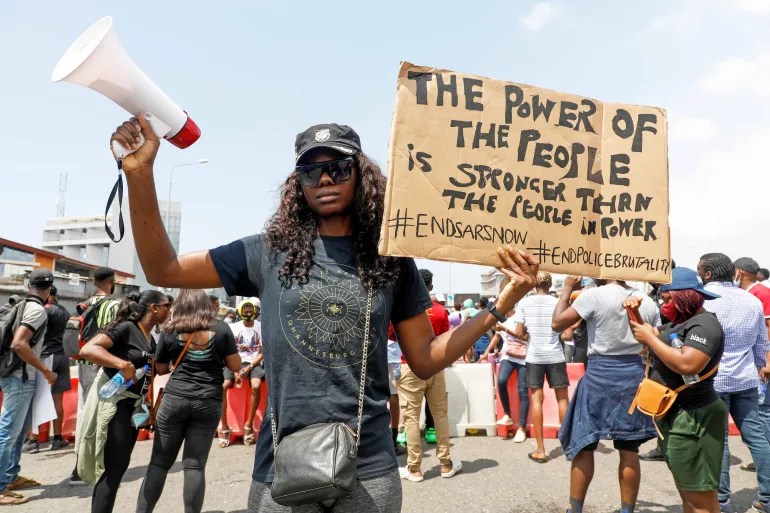
The #EndSARS protests of 2020 marked a turning point in Nigeria’s political history, not simply as a mass uprising against police brutality, but as a moment that reshaped political consciousness, particularly among young people. Although the protests were violently suppressed and did not immediately produce sweeping institutional reforms, their long-term impact lies in how Nigerians now understand power, the state, and their own political agency.
Before EndSARS, political engagement among many young Nigerians was often fragmented, episodic, or limited to social media commentary and election cycles. EndSARS altered this dynamic by demonstrating the possibility of leaderless, decentralized mass mobilisation. It showed that collective action could emerge outside political parties, ethnic blocs, or traditional civil society structures. This reoriented political awareness away from elite-driven politics toward people-powered participation.
One of the most significant shifts in post-EndSARS consciousness is the erosion of blind trust in institutions. The protests, and especially the events surrounding the Lekki Toll Gate incident, deepened public skepticism toward the state’s commitment to accountability, rule of law, and citizen protection. For many Nigerians, this moment confirmed long-held suspicions that state violence is systemic rather than accidental. As a result, political awareness has become more critical, less deferential, and more interrogative.
EndSARS also expanded the definition of politics itself. Political engagement is no longer seen only as voting, joining a party, or running for office. Mutual aid, legal fundraising, digital documentation, protest art, street memorials, and online archiving became recognised as political acts. This broadened understanding persists in post-EndSARS Nigeria, where culture, language, fashion, and digital expression are increasingly politicised.
The movement also produced a new political vocabulary. Terms such as accountability, decentralisation, state violence, and civic rights entered everyday conversations, particularly among young people. This language has endured, shaping how policies, elections, and government actions are discussed. Even when youth participation in formal politics remains limited, political literacy has expanded.
However, post-EndSARS consciousness is also marked by disillusionment. The absence of justice for victims, the perceived normalisation of impunity, and the failure of political elites to meaningfully respond have generated cynicism. Many Nigerians now approach politics with a mix of awareness and fatigue, believing the system is resistant to change. This has led some to disengage from electoral politics altogether, while others seek alternative forms of influence outside the state.
Despite this, EndSARS left behind an organisational memory. Networks formed during the protests continue to resurface during elections, humanitarian crises, and social campaigns. While fragmented, these networks represent a latent political infrastructure that did not exist at scale before 2020. The experience of collective action has not disappeared; it has been stored.
Another key outcome is the politicisation of the diaspora relationship. Nigerians abroad played a visible role in amplifying EndSARS globally, influencing how international attention, funding, and advocacy intersect with local struggles. Post-EndSARS consciousness now includes an awareness of global visibility as a political tool, even as it raises questions about representation and accountability.
In essence, EndSARS did not produce immediate structural transformation, but it permanently altered perception. Nigerians, especially the youth, are now more aware of how power operates, how narratives are controlled, and how quickly solidarity can be mobilised. The post-EndSARS political consciousness is cautious, informed, and unresolved, suspended between hope and realism.
What EndSARS ultimately achieved was not regime change, but a shift in political imagination. It made it harder for the state to claim unquestioned legitimacy and harder for citizens to see themselves as politically irrelevant. Whether this consciousness evolves into sustained institutional power remains uncertain, but the psychological and cultural rupture EndSARS created continues to shape Nigeria’s political future.


 Culture Beyond the Mainstream