
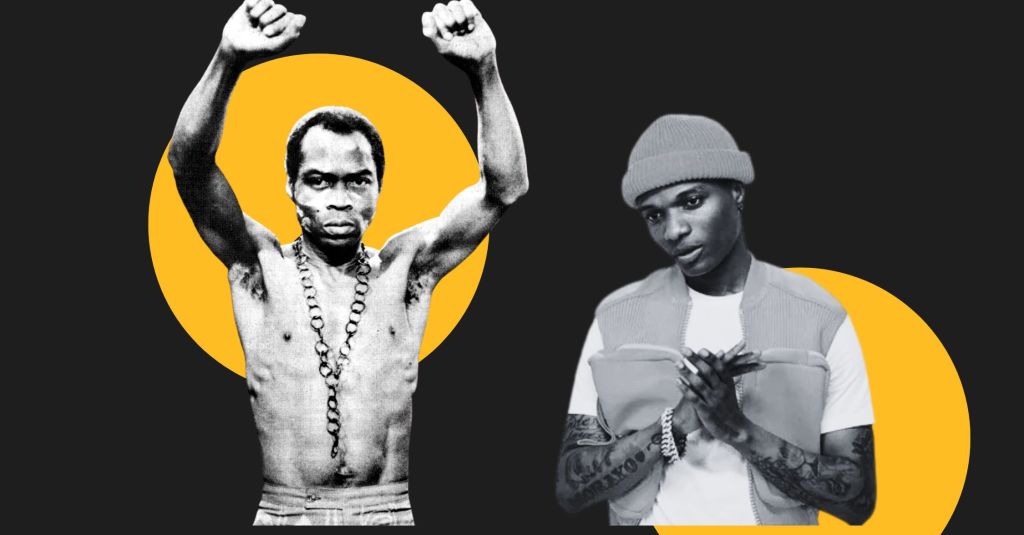
Fela Kuti’s legacy occupies a sacred place in African and global cultural history, and it deserves to be treated with depth, context and respect. The recent tendency among some Gen Z audiences to diminish or dismiss Fela’s impact in favour of contemporary stars like Wizkid reflects a misunderstanding of history rather than a genuine cultural debate. Both artists are legends of their own time, but placing them in direct competition ignores the vastly different roles they played, the eras they lived in and the risks they took.
Fela Kuti was not just a musician. He was a revolutionary figure who used sound as a weapon against oppression. At a time when Nigeria was under a hostile military government, Fela created Afrobeat as a genre that fused music, politics and resistance. His songs were not designed for comfort or commercial success. They were confrontational, unapologetic and deeply political. Through his music, Fela spoke directly to the struggles of the masses, naming corruption, military brutality and social injustice at a time when doing so came with severe consequences.
Those consequences were real and brutal. Fela was arrested repeatedly, beaten, imprisoned and harassed by the state. His home was attacked, his family suffered violence and his life was constantly under threat. Yet he refused to be silent. This fearlessness is central to his legacy. Fela’s impact cannot be measured by charts, awards or global tours alone. It lies in the courage it took to stand against power when silence would have been safer. Afrobeat became global not because it was fashionable, but because it carried truth, anger and resistance that resonated far beyond Nigeria.

Wizkid, on the other hand, is a defining figure of modern Afrobeats and deserves recognition for his achievements. He has taken African music to global stages, collaborated with international stars and built a massive global fanbase. His success has opened doors for a new generation of African artists, and his influence on contemporary pop culture is undeniable. Wizkid himself has acknowledged Fela’s importance and has openly shown respect, even tattooing Fela’s image on his body as a sign of admiration.
However, acknowledging Wizkid’s greatness does not mean placing him on the same historical plane as Fela Kuti. Their contributions are fundamentally different. Wizkid operates in an era shaped by the groundwork Fela and others laid. He benefits from an industry that already exists, from global infrastructures that allow African music to travel freely. Fela had no such luxury. He built something where nothing existed and paid a heavy price for it.
Comparing the two is like comparing impact to reach. Wizkid may have more listeners today than Fela ever did in his lifetime, but Fela made the impact that made such reach possible. Afrobeat and its global evolution did not appear out of nowhere. It emerged from Fela’s vision, defiance and sacrifice. That foundation cannot be erased or replaced by popularity metrics.
Disrespecting Fela’s legacy is not an expression of loyalty to Wizkid, nor is it a reflection of progress. It is a loss of historical awareness. There is room to celebrate both men without diminishing either. Fela Kuti was a fearless political force who fought for the oppressed and reshaped African music forever. Wizkid is a global superstar who represents the possibilities of that legacy in a modern world. They are not rivals. They are not comparable in a competitive sense. They are two legends of different eras, connected by influence, not hierarchy.
Afrobeats today exists because Fela Kuti made it possible. That truth stands regardless of trends, fan wars or generational shifts, and it deserves to be honoured, not debated.




 Culture Beyond the Mainstream