
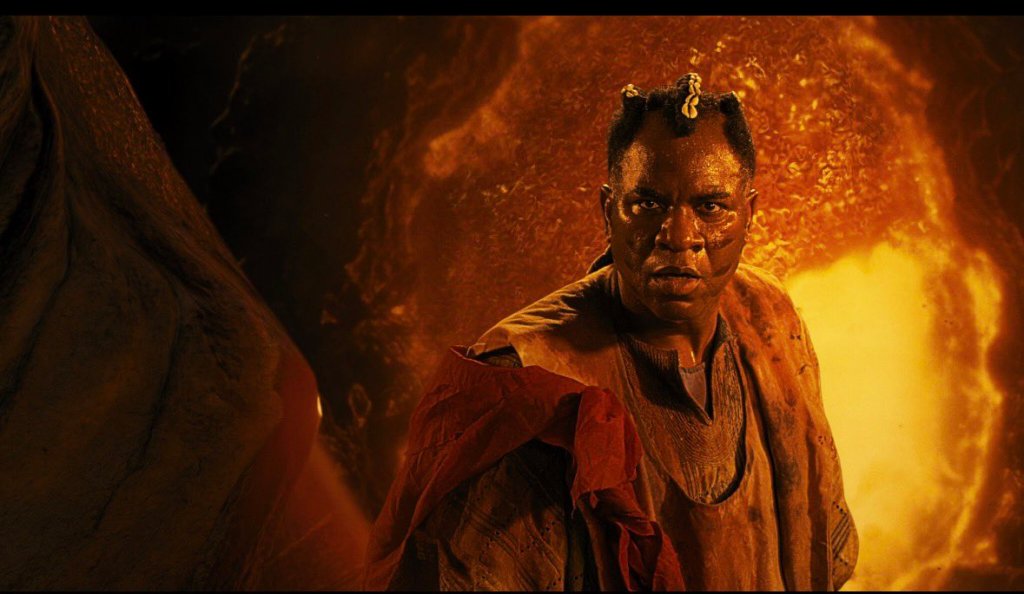
Kunle Afolayan’s Aníkúlápó arrived with enormous cultural weight when its first season premiered. Rooted in Yoruba mythology and powered by strong visual ambition, it promised a cinematic universe that could evolve with depth, mysticism, and technical growth. Unfortunately, Aníkúlápó: Season 2 – The Ghoul Awakens, struggles to live up to that promise and ultimately falls short of expectations.
One of the most immediate issues with the new season is its failure to connect coherently with the previous one. Rather than easing viewers back into the story world, Season 2 opens in a way that feels disjointed and confusing. Key narrative threads from the first season are either weakly referenced or awkwardly repositioned, making it difficult to understand how events logically flow from one chapter to the next. For viewers expecting continuity or emotional payoff from earlier storylines, the disconnect is frustrating and alienating.
The confusion at the start of the season sets a tone that never quite recovers. Instead of intrigue, the opening episodes generate uncertainty without purpose. The storytelling lacks clarity, and rather than drawing viewers deeper into the mythology, it creates distance. A series built on lore and mysticism depends heavily on narrative precision, and this is where The Ghoul Awakens falters early.
Visually, the disappointment deepens. One would reasonably expect an improvement in visual effects from the first season, especially given the scope of the story and the growing global attention on Nigerian cinema. Instead, the visual effects in Season 2 appear noticeably weaker. The CGI often feels unfinished and unconvincing, breaking immersion rather than enhancing the supernatural elements of the story. For a series that leans heavily on fantasy and myth, this decline in visual quality is particularly damaging.
Pacing is another major issue. The season feels unnecessarily dragged, with scenes that linger without adding substance to the plot or character development. What should be tense or emotionally charged moments often stretch into monotony, causing the narrative to lose momentum quickly. Rather than building anticipation, the slow pacing makes the series feel heavy and dull.
This lack of engagement ultimately makes the show difficult to sustain as a viewer. By episode two, the story already feels repetitive and uninspired, offering little incentive to continue. When a series loses its ability to hold attention so early, it signals a deeper problem with structure, direction, and creative focus.
In the end, Aníkúlápó: Season 2 – The Ghoul Awakens feels like a missed opportunity. Despite its rich cultural foundation and the pedigree of its creator, the series struggles with narrative clarity, visual execution, and pacing. Instead of elevating the Aníkúlápó universe, it dilutes its impact. For many viewers, this season will not just fall short of expectations—it will stand as a total miss.

 Culture Beyond the Mainstream