
There is something immediately likeable about Phin, Addy, Chloe & Snowy’s Big Adventures. It is a book written from a place of affection by Sangeetha Joseph. You can feel that the author genuinely loves these children, loves these dogs, and understands the particular magic that exists between children and the animals they grow up alongside.
The book does not try to manufacture grand drama. Instead, it finds adventure in the familiar: a rainy evening in the living room, a day at the seaside, a morning spent getting ready for school. That choice is one of its greatest strengths. For young children, an ordinary day can feel enormous. A blanket fort can become a castle. A beach can become an entire kingdom. A missing dog can turn a family afternoon into a search party. The book understands this instinctively. At its heart, this is a story about four best friends who happen to be two children and two dogs, and that is where the book has its greatest emotional appeal.
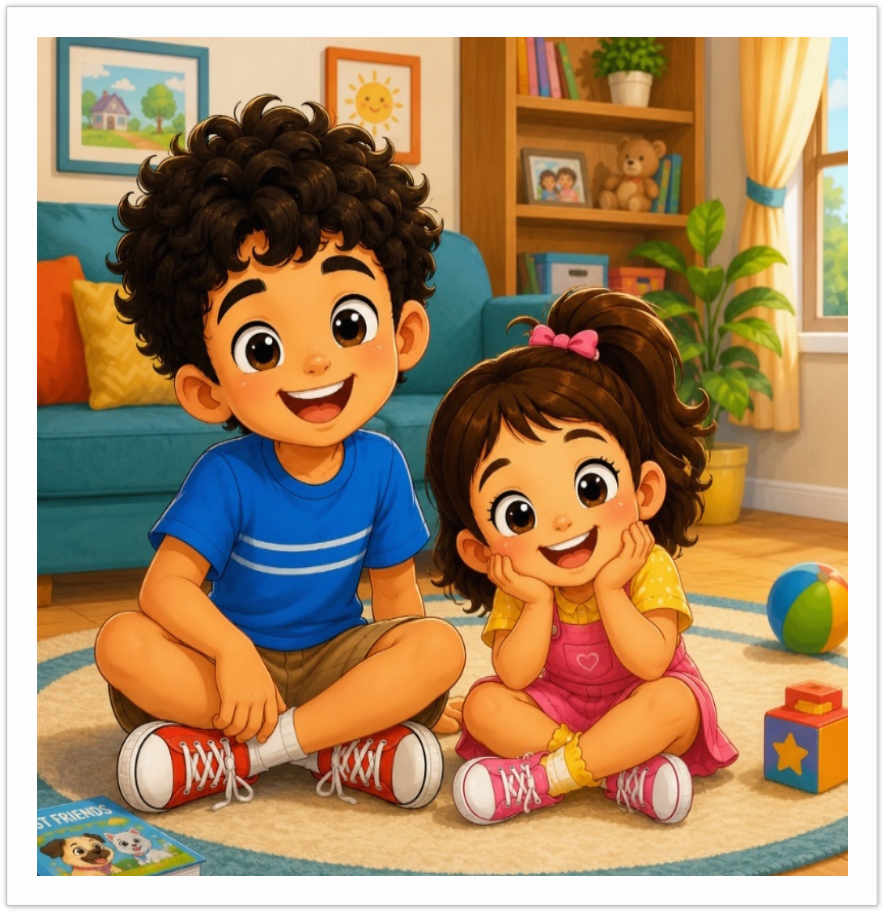
Phin and Addy are clearly defined as children with different personalities. Phin, at nine, is thoughtful, inventive and inclined towards problem-solving, while four-year-old Addy is more exuberant, curious and playful. Chloe and Snowy have their own personalities too: Chloe is food-loving, sleepy and slightly mischievous, while Snowy is energetic, playful and forever getting into things.
The author makes an important choice here: the dogs are not simply decorative pets. They are members of the little family. That distinction matters. Chloe has agency. Snowy contributes to the action. They have habits, quirks and relationships with the children. Snowy tracking Chloe at the beach is particularly effective because it allows the dog’s nature to become part of the story rather than simply having an adult solve the problem.
The book’s emotional centre is therefore not really the individual adventures. It is the bond between the four characters. That becomes especially clear in the third story. The children go to school, and suddenly the house is quiet. Chloe waits. Snowy searches. Phin thinks about the dogs at school. Addy draws them. The eventual reunion is simple, but it works because the separation has established how much these four characters matter to one another. There is a genuine tenderness in that.
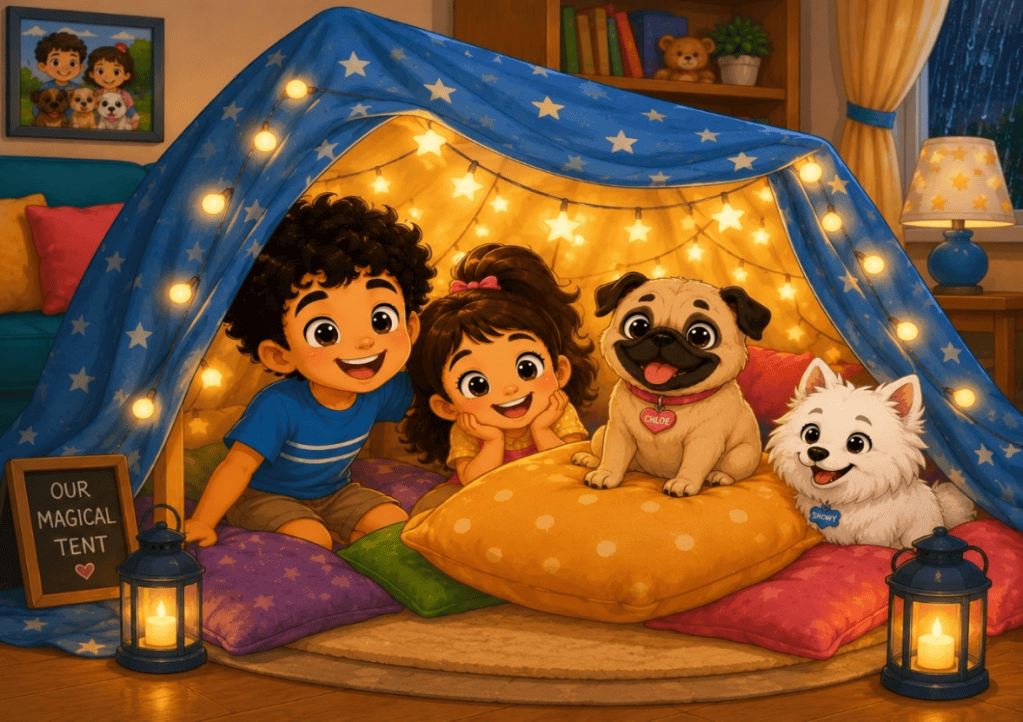
The first story, Phin and Addy’s Cosy Story Night, is perhaps the most charming in terms of atmosphere. A rainy evening, bored children, blankets, cushions, fairy lights and a storybook are ingredients that young readers will immediately understand. The living-room tent is an especially good idea because it takes something completely ordinary and transforms it through imagination.
The story succeeds because it understands that children don’t need expensive entertainment. Give them a few blankets and cushions and suddenly the sofa becomes a castle. The moment when the tent collapses is also useful structurally. It gives the story a small problem without introducing unnecessary danger. More importantly, the children rebuild it together. Phin fixes the chairs, Addy gathers cushions, Snowy fetches a pillow, and Chloe supervises. That is exactly the kind of low-stakes conflict that suits the tone of the book.
There is, however, an opportunity here for the writing to go further emotionally. The story tells us quite clearly what is happening and how everyone feels. A stronger literary version might occasionally allow us to discover those feelings through behaviour, silence, expression or small details rather than explaining them. The book is at its best when it simply lets us see the children and dogs together. The image of everyone falling asleep inside the rebuilt tent is stronger than any explanation of why the moment is magical.
The closing thought “Sometimes the most magical adventures happen right at home” captures the philosophy of the story well. It is sincere rather than cynical, and that sincerity is one of the book’s most attractive qualities.
The second story, Chloe and the Seaside Story Club, introduces the strongest piece of conventional adventure. The seaside setting immediately opens the world of the book. The sandcastle, moat, towers, shells and seaweed crown give the story a playful visual quality, while Chloe’s attraction to the smell of a hotdog provides the problem. There is something very believable about Chloe wandering away because she has followed food. It feels like something this particular dog would do.
The best character beat in the story may actually be the seaweed crown and Chloe being named queen. It says a great deal about the children’s relationship with her without requiring much explanation. In their world, Chloe isn’t merely a dog sitting beside a sandcastle. She is the queen of it.
The search sequence raises the stakes appropriately. Phin tells Addy to stay close, Snowy follows Chloe’s pawprints, and the children involve adults rather than trying to solve everything themselves. That is a responsible way of handling a potentially frightening situation in a children’s story.
Then comes the story club. This is where the book becomes most whimsical. Chloe has somehow wandered into a group of older men and women listening to a story, and the elderly woman explains that the dog has joined their “storybook club.” It is a lovely idea. There is something almost quietly beautiful about it: Chloe, who wandered away because she smelled food, ends up somewhere where people are gathered simply to listen to a story.
The scene also widens the world of the book. It suggests that storytelling is not something belonging only to children. It belongs to everybody. That is a lovely underlying idea, even if the story does not fully explore it.
From a critical perspective, the resolution is perhaps a little too neat. Chloe’s disappearance is potentially the most emotionally serious event in the book, yet the danger passes quickly once Snowy finds her. A little more time spent inside Phin and Addy’s worry could make the eventual reunion considerably more powerful. The ingredients for a moving scene are already there. The book simply doesn’t squeeze all the emotion out of them.
The third story, Phin and Addy’s Long Day at School, is, in my view, the quietest and most emotionally mature of the three. Nothing particularly extraordinary happens. And that is precisely why it works. The children go to school. The dogs stay home. Everyone misses everyone else. There is no villain, no dramatic adventure and no elaborate plot. Instead, the story observes the small ache of being separated from someone you love.
Phin tells his school friends about Chloe and Snowy. Addy draws a picture of the family. Chloe sleeps on Phin’s jumper. Snowy stays beside Addy’s teddy. Those details carry more emotional weight than a large dramatic event would. The image of Chloe sleeping on Phin’s jumper is particularly effective. It tells us that she misses him without the story having to say much.
Likewise, Addy’s decision to save cheese for Chloe and then eat it herself is a wonderfully childlike detail. It gives the story humour while also revealing affection. And then the reunion comes. Snowy races out. Chloe waddles towards them. There are kisses, cuddles and the four friends are together again. It is uncomplicated. It is also honest.
The story understands something adults sometimes forget: children can have a perfectly good day at school and still be desperate to get home.= The biggest opportunity is depth rather than plot. The stories already have enough happening in them. What they sometimes need is more room to breathe.
The writing frequently tells the reader what the characters are feeling instead of allowing the reader to experience those feelings through the scene. For example, when the children miss the dogs at school, the emotional idea is strong. But a few carefully chosen sensory details—a glance at the clock, an empty space beside the bed, the sound of a familiar collar at home, could make the absence feel much more tangible. The same applies to the beach story. Phin and Addy being unable to find Chloe is potentially a genuinely emotional moment. The reader could be allowed to sit with that fear for slightly longer before the solution arrives.
There is also room for more distinctive dialogue. The children’s voices are clear in concept, but stronger individual speech patterns would make Phin and Addy feel even more like real siblings. Addy’s age, in particular, could be reflected more strongly in the rhythm and logic of her speech. In other words, the book has good characters waiting for even more specific voices. The prose is deliberately simple and accessible, which is appropriate for the intended audience. It moves quickly and is easy to follow. But simplicity should not be confused with flatness.
The next level for this book would be to introduce more sensory and visual language without making the prose complicated. The smell of the rain, The softness of the blankets, The sound of Snowy’s paws, Sand sticking to little fingers, The sea wind moving the pages of a book, Chloe’s sleepy breathing, These small things would give the world texture. A child does not need difficult vocabulary to experience beautiful writing. Sometimes one precise detail is worth a paragraph of explanation.
The three-story structure works well because each story explores a different kind of adventure. The first is imagination, the second is discovery and worry, the third is separation and reunion. Together they create a gentle progression from play, to adventure, to emotional reflection. The recurring idea of the four friends is also effective. By the end, the reader understands that the title is not really referring to three separate adventures. The real subject is the friendship between Phin, Addy, Chloe and Snowy. That is what holds the book together.
The greatest strength of Phin, Addy, Chloe & Snowy’s Big Adventures is also the thing that needs to be protected most carefully: its sincerity. There is no irony here, no attempt to make the story clever for adults, no need to make the dogs talk like humans, no unnecessary darkness. It is simply a book about children who love their dogs and find adventure in everyday life. That sounds simple, It isn’t.
Writing something gentle without making it dull is difficult, writing something sentimental without making it manipulative is even harder. This book comes close because the affection feels genuine. What it needs now is not a bigger story, it needs richer storytelling. The foundation is already there. The characters are lovable. The situations are accessible. The central relationship is strong. The tone is warm. The next step is to trust the scenes more, to let moments linger, let emotions emerge naturally, give the children more individual voices, and replace some explanation with observation. There is a sweetness here that should not be edited away.
The book would benefit from more textured prose, stronger individual dialogue, greater emotional breathing room and slightly more sophisticated scene-building. But those are improvements to the craft, not a rejection of the heart. The heart is already beating, and that may be the most important thing a children’s book can have.
Phin, Addy, Chloe & Snowy’s Big Adventures is a warm, wholesome and genuinely affectionate children’s book. Its greatest achievement is that it understands the emotional scale of childhood: a blanket fort can be an expedition, a sandcastle can become a kingdom, and being away from your dog for a school day can feel like a very long separation. It is not a book built around complicated plotting, It is a book built around belonging. And that is why the final idea of the four characters being “best friends” lands. By the end, the reader has watched them build, explore, worry, wait, laugh and reunite. The adventures may be small by an adult’s measure, but they are exactly the right size for the world these characters inhabit. There is a sweetness here that should not be edited away. The book feels like it was written because these four characters matter to the person who created them. That feeling is worth preserving.